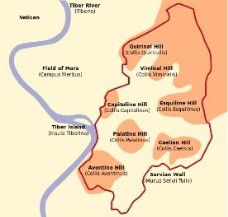
The Caelian Hill, one of the City’s traditional seven hills, stood out as a wealthy residential district during republican and imperial ages. Because the hill lay outside the boundary wall of the City, temples to foreign divinities such as the Temple of Minerva Capta flourished there. In the Middle Ages its proximity to the Lateran Cathedral and papal palace promoted the construction of several new churches: the basilicas of San Giovanni e Paolo, Santa Maria in Domnica, Santo Stefano Rotondo, and others. Set on the edge of this hill and opposite the side of the Palatine Hill lies the church of San Gregorio Magno, dedicated both to Saints Andrew and Gregory I (Great).
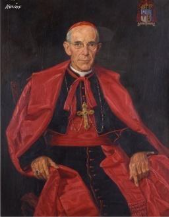
According to legend, in imperial times Gregory the Great (gens Anicia) inherited his father’s house here and on it founded a monastery which he dedicated to St. Andrew the Apostle. Here he lived as a monk for 15 years before his election to the papacy in 590. In 596 Gregory sent its prior, Augustine, with 40 monks as missionaries to England where Augustine established the cathedral of Canterbury. Because of its ties to England, San Gregorio has served as the titular church of several English cardinals (Manning, Vaughn, Godfrey). It connected as well to an American, a member of the Congregation of Holy Cross, Cardinal John O’ Hara csc, former president of the University of Notre Dame and Archbishop of Philadelphia.
Near the entrance of the portico stands a column inscribed with the names of Augustine and other missionaries to England. In the 8th century Greek monks rebuilt and occupied the monastery at a time when monastic life in the City was dominated by Greek-speaking monks, refugees from the East. Because of Islamic expansion there and the iconoclast policies promoted by the Byzantine emperor Leo III many had sought refuge in the City. In the 10th century, the reformed Benedictine abbey of Cluny obtained possession of the property and established a priory there. The present church, probably built in the late 12th century. has been often restored and remodeled. More recently, French troops during the Napoleonic occupation of Rome around 1809, caused severe damage to the monastery.
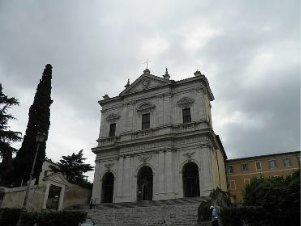
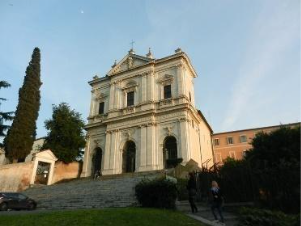
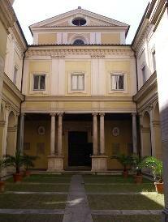
Piazza di San Gregorio remains a beautiful remnant of antiquity. Mediaeval monasteries had open areas like this outside their gatehouses. These served as social centers and marketplaces, the reason why, in many cases, monasteries in Europe gradually grew into towns. Preceded by a wide staircase the church rises from the piazza below which enhances the effectiveness of the approach to the church which sits higher on the hill. The imposing façade, unusually, does not directly front the church itself but, instead, the forecourt (peristyle) through which one passes to enter the church. Cardinal Scipio Borghese, nephew of Pope Paul V, commissioned the architect Giovanni Battista Soria to create the portico with its arcaded walkways, completed in the mid-17th century and regarded as Soria’s masterpiece. It showcases two stories, divided into three vertical sections, each with an arched portal. The Borghese coat of arms appears prominently throughout the space. Three rectangular windows in the second story correspond to the portals below.
Tombs and memorials, including that of Sir Edward Carne, a 16th century envoy of Queen Mary I of England to the papal court, line the open space in front of the church. In 1511 Imperia, the mistress of the wealthy banker Agostino Chigi, was buried in a tomb here in the portico. It was later replaced in the 17th century, however, by the tomb of Canon Lelio Guidiccioni. Three large doors face the courtyard.
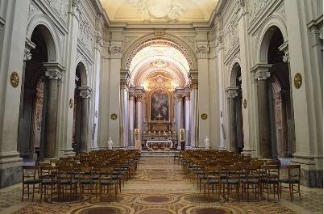
Inside the church arcades separate the central nave and aisles. Ancient Ionic columns which probably belonged to the mediaeval church support the arches: eleven of grey granite and five of marble. A barrel-vaulted ceiling sits over a floor composed of beautiful 13th century Cosmatesque polychrome marble. Fronting the sanctuary lies a triumphal arch supported by fluted columns. It holds two 15th century statues of Saints Gregory and Andrew. An altarpiece painting depicts The Madonna and Child with Saints Andrew and Gregory.
Next to the apse on the right is the Chapel of St. Gregory.

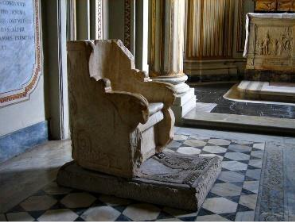
In front of the chapel sits a 1st century Roman marble throne, the Chair of St Gregory, traditionally regarded as Pope Gregorys cathedra on which he sat when he presided at liturgical celebrations.
St. Gregory’s cell remains beyond a doorway on the right side of the chapel. It leads into a small space venerated as the original space where St. Gregory lived. The rooms contain two niches, protected by bronze grilles. The smallest niche is the space where St. Gregory slept (lettuccio). On the left lies the Salviati Chapel, a 16th century family mortuary chapel designed by Carl Maderno and large enough to be a small church in itself with its raised sanctuary and dome. On a wall hangs a frescoed icon of the Madonna which according to legend spoke to St. Gregory. The altarpiece consists of a copy of Annibale Carracci’s St. Gregory at Prayer. A wooden iconostasis now divides the sanctuary into two sections because used as worship space by Byzantine Romanian Catholics.
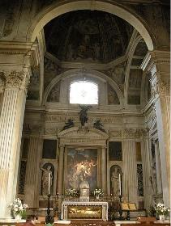
The church includes several other chapels: the Chapel of the Immaculate Conception; The Gabrielli Chapel; Chapel of Blessed Michael Pini.
Garden Chapels
Outside of the church, to the left of the portal, and up a flight of stairs grows a garden sheltering two medieval chapels: those of Saints. Barbara and Andrew. Yet a third chapel was later added in the 17th century and dedicated to St. Silvia, mother of St. Gregory. The 12th or 13th century Santa Barbara Chapel was restored in the 16th century. An inscription on the doorway lintel (Triclinio di San Gregorio) recalls the legend that in this space Gregory provided food to the poor. Twelve people per day gathered from the streets of the City, served by the saint himself. Gregory’s 3rd century table, a marble slab, rests on a fragment of granite column.
Frescoes with episodes from the life of the saint decorate the walls and the apse contains a large, seated marble statue of St Gregory. One fresco details the story of the day when thirteen people, instead of twelve, arrived to eat, the thirteenth, an angel.
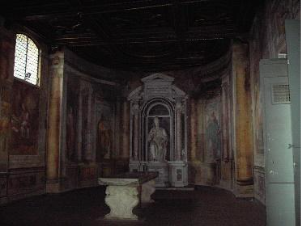
Saint Andrew’s Chapel, the middle chapel and no longer in use, was built in the 11th or 12th century. It contains a fresco by Domenichino (Flagellation of St. Andrew and two by Guido Reni (Saints Peter and Paul on one side of the altar and St. Andrew on the other side). The Chapel of Santa Silvia, built in the early 17th century, rests over her tomb, and shares the same design as that of the Chapel of Santa Barbara.
Guido Reni painted the fresco in the apse, The Musical Concert of Angels.
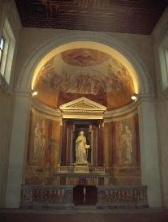
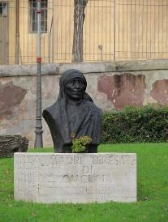
Next to the basilica and monastery, Saint Teresa of Calcutta and her religious congregation, the Missionaries of Charity, established in 1968 a convent for their religious sisters. The community, spread all over the world, serves the needs of the world’s poorest irrespective of race, creed, or social class. Sisters of the house welcome visitors and happily show them spaces she frequented when in residence: chapel, bedroom, reception parlor.