
Of the many ancient buildings in the City, the Pantheon stands out as one of the most recognizable, widely regarded as the greatest surviving monument of ancient Roman architecture. As early as the 8th century the medieval scholar, the Venerable Bede, said of it: “whoever leaves Rome without seeing the Pantheon, leaves Rome a fool.” If architecture can be described as spatial sculpture, no building in the City, perhaps, even in the world, does this better than the Pantheon. Despite its highly intriguing and complex structure, it combines ingeniously the simple, basic elements of the square, circle, and triangle throughout. Even more, it successfully creates the visual impression of one calm and majestic harmonious whole, symbolic of its builders’ aspirations to celebrate the universal order and peace wrought by the Roman Empire and imposed upon the world.Right up till the 20th century, it remained, remarkably, the largest, unreinforced, concrete dome anywhere. Even more remarkably, many of its original features remain today: granite columns in the portico, bronze doors of the main entrance, giallo-antico interior columns, coffered ceiling, and the restored marble floor, making it the best preserved of the City’s ancient monuments. Many architects and historians claim that is one of the most influential buildings in the history of Western civilization, the inspiration for later world-famous buildings: Justinian’s Hagia Sophia in Istanbul, Julius II’s 16th century St. Peter’s in the City, and the 19th century Capitol Building in Washington D.C. Of it, Michelangelo remarked justly that its design was “angelic, not human”.

A 17th century inscription of Pope Urban VIII on the right side of its bronze door rightly describes it as the most famous building in the whole world (“Pantheon aedificium toto orbe terrarium celeberrimum”). To go to the City without a visit to the Pantheon is akin to going to St. Peter’s without gazing upon Michelangelo’s Pieta.

The Pantheon rose in the area called the “Goat Marsh” (Palus Caprae), an open wetland in the Campus Martius section of the city (1.25 square miles) where Romulus, according to legend, had been apotheosized. During a thunderstorm when he was reviewing the army near a shrine dedicated to his ancestor, Mars, the god of war, he was taken up to the heavens and to reside there in the company of the gods. Thereafter, deified in Roman myth, he would be associated with the ancient Sabine god, Quirinus.
.jpg?mode=max)
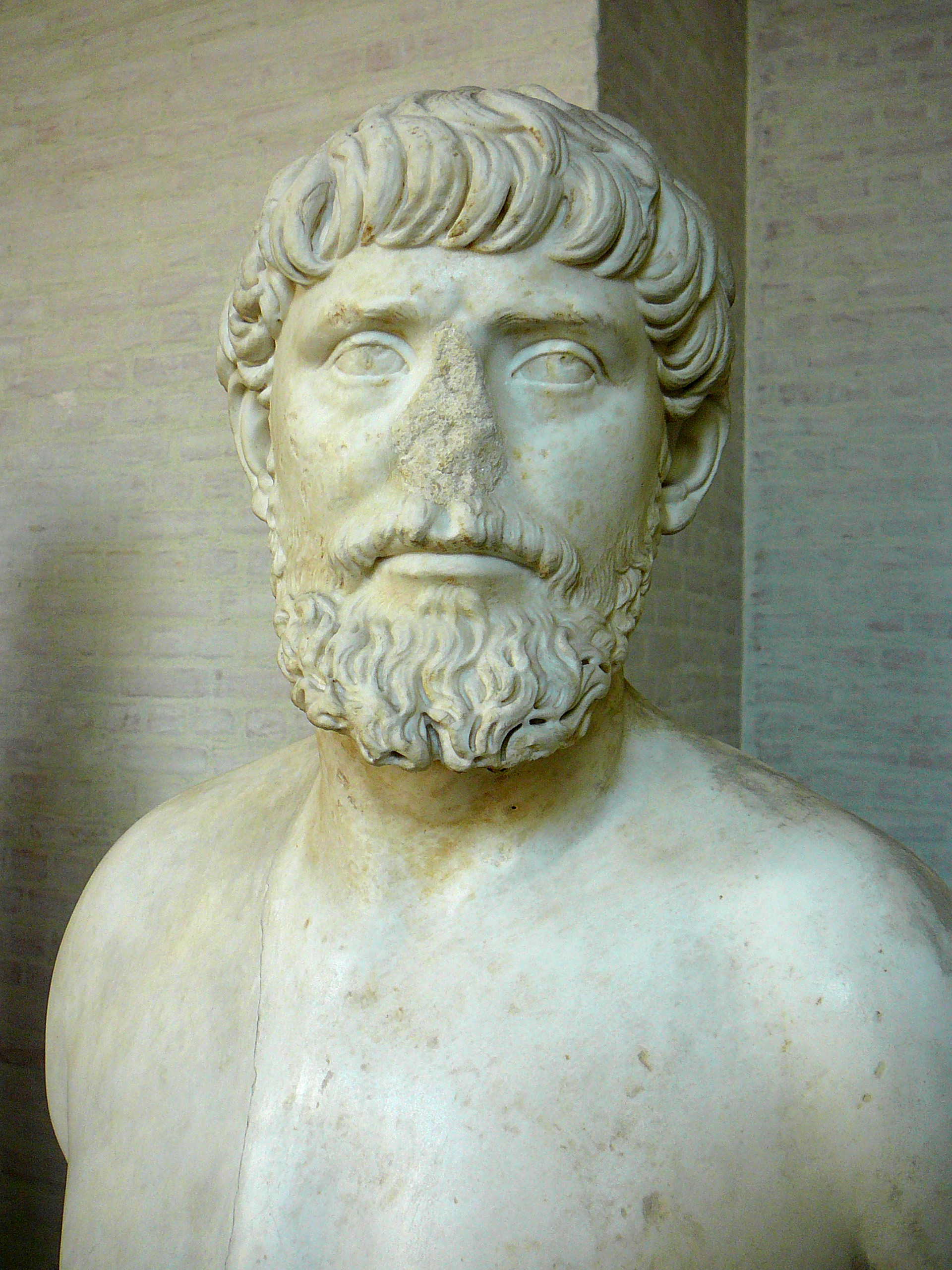
In the Republican period, the uninhabited area around the Pantheon served mostly as a site where soldiers trained outside of the Servian Wall. In the Imperial Age the construction of more and more public buildings resulted in the incorporation of Campo Marzio into urban space. Augustus’ son-in-law, Marcus Vispanius Agrippa, built the Pantheon here in this unprepossessing habitat. Agrippa was one of the City’s most remarkable citizens. A schoolmate, friend, confidant, counselor, and brother-in-law of Augustus, he played a major role in the great military and political
achievements of the emperor throughout his career. He won many military battles for Augustus and his victory over Marc Antony at the Battle of Actium in 31 BC virtually enabled Augustus to achieve imperial Roman authority. It is said that Maecenas, close friend of and personal adviser to Augustus, told the emperor that because he had given Agrippa so much power, he either had to make him his son-in-law or kill him. Fortunately, Agrippa, a widower, joined Augustus’ family by marrying his niece, Claudia
Marcella. A remarkably successful political figure, Agrippa held all public offices available to Roman patricians (the ‘cursus honorum’), wrote scholarly treatises on geography, and aided Augustus in ‘transforming a city of brick to one of marble’ by constructing temples, baths, porticoes, roads, open space, and gardens. In the year 33 BC alone, Agrippa was responsible for creating 105 fountains throughout the City. His reach even extended to the Cloaca Maxima when he supervised its dredging and
repair. When Agrippa died in 12 AD, two years before Augustus, the emperor insisted that he be buried in the imperial mausoleum with the members of the Julio-Claudian dynasty. His magnificent porphyry sarcophagus remains, now in the church of St. John Lateran, and contains the body of Pope Clement XII. In addition to the Pantheon, Agrippa constructed also the first public baths in the City, an artificial
lake, a large colonnaded portico, and a temple dedicated to Neptune.

For the Romans the Pantheon served as a temple to worship especially the planetary gods, but, as well, it functioned practically as a site of the ruler cult, a place where rulers could appear in public” with all the gods” while retaining the appearance of a typical temple organized for the worship of state divinities. After the overthrow of the Etruscan monarchy, Romans resisted ferociously all efforts to restore any form of monarchical rule. Agrippa’s temple served even more as a camouflaged kind of ruler cult dedicated ostensibly to planetary gods but indirectly to the imperial Julian
family, patrons of those same gods. The present structure represents the third iteration of the temple. Fire damaged twice earlier constructions. Very unusually for its time, the internal cella of the structure served as the focal point of the whole. The architect of the Emperor Hadrian, Apollodorus of Damascus, departed from the traditional pattern of Greek temples which placed virtually all emphasis on the exterior structure. Composed of non-moldable, hewn stone, traditional Greek temples integrated upright columns and straight lintels. Because Romans, however, exploited the use of a new building material, malleable cement, they were able to create curved, three-dimensional structures such as the Pantheon.
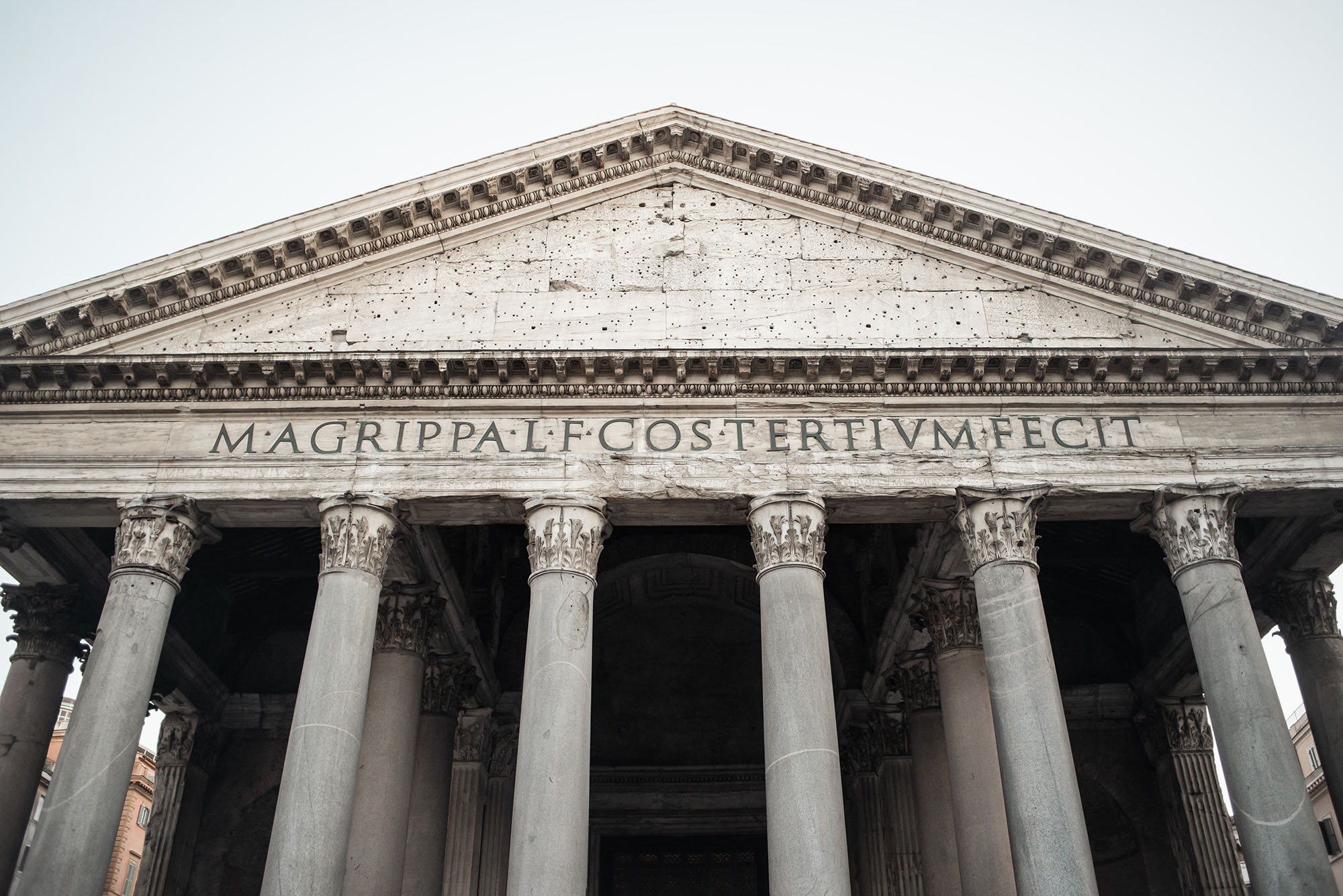
For many years people believed erroneously that Agrippa constructed the current version of the Pantheon. The inscription on the entablature, in fact, states explicitly that Agrippa had constructed the temple during his third consulship. Hadrian, however, out of respect for the illustriousness of Agrippa and the Julio-Claudian dynastic line he represented, incorporated the original inscription into the new temple’s façade. The tympanum above the entablature once held in bronze relief an image of the chief god, Jupiter, casting down to Tarturus (underworld) the Titans, his rebellious kinsmen.
In 395 AD Emperor Theodosius closed this temple as a place for pagan worship. In 608 it became a Christian church when the Greek Emperor Phocas donated it to the papacy. In return, the Roman Senate ordered the erection of a still surviving column in the Forum in honor of that same emperor. It remains as the very last ancient Roman monument ever erected in the Forum.

In the Middle Ages the Orsini and Colonna clans converted the Pantheon into a family fortress. Later popes replaced three columns stolen in the Middle Ages. In the 17th century Pope Urban VIII substituted one column and Pope Alexander VII the others, all removed from the Baths of Nero behind Piazza Navona near the church of San Luigi dei Francesi. The Chigi (Pope Alexander VII) replacements stand on the left side of the portico, readily identifiable by their redder color and by the higher quality of their
less damaged capitals.

Pope Urban VIII (1623-1644) quarried the portico ceiling for the bronze (200 tons) he needed to cast the baldacchino in St. Peter’s and, as well, cannons and cannon balls for Castel Sant’Angelo. After 1870 when Italy became a constitutional monarchy and a unified national state, the State expropriated the Pantheon and transformed it into a national shrine, the burial site of the royal family of the House of Savoy. Very ironically, the melted-down bronze cannons and cannon balls taken from Castel Sant’Angelo years before now became the major ingredients for the new bronze tombs of the royal family.

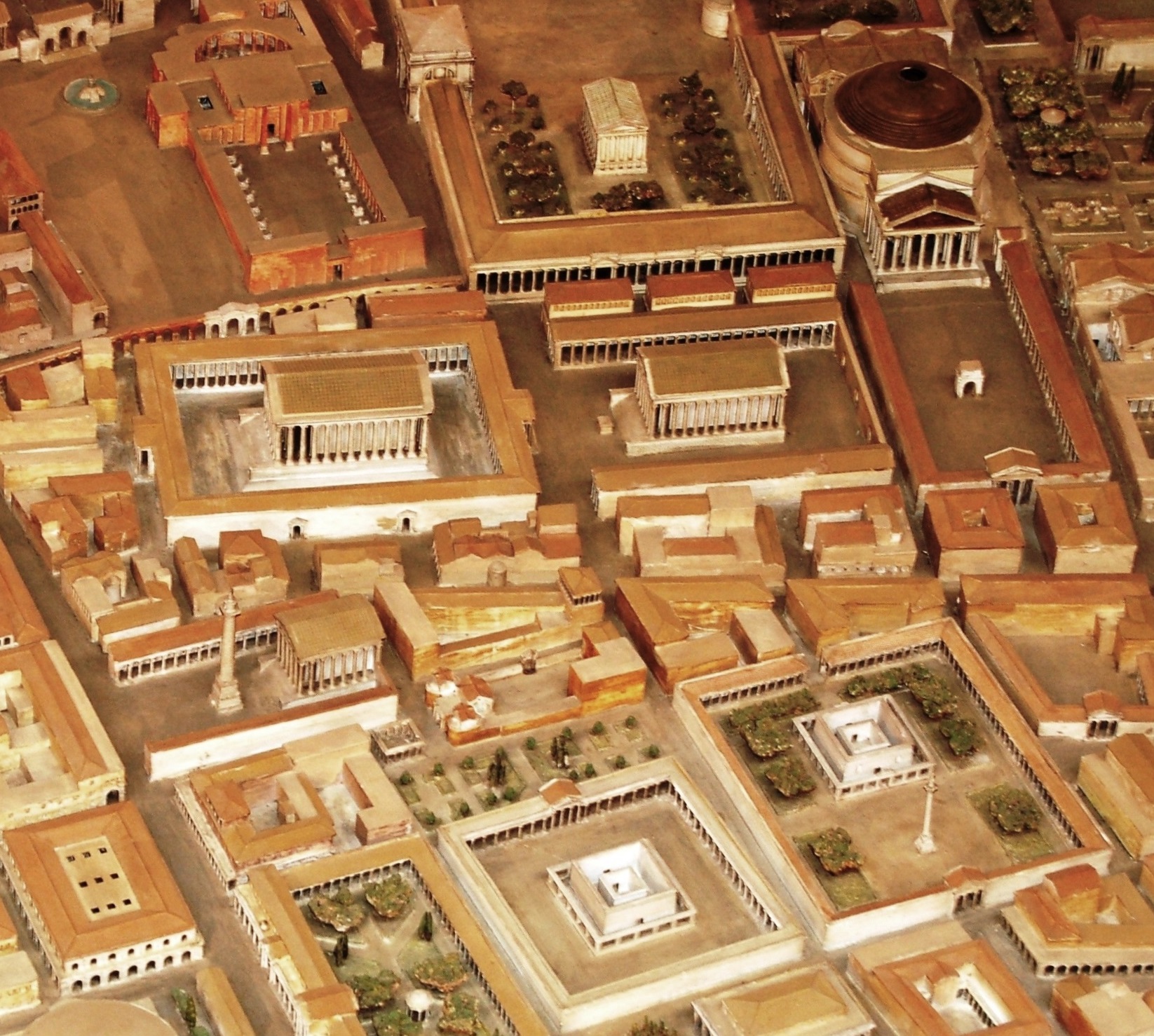
Despite multiple restorations to the monument, visitors see mostly completely original structures: the coffered dome, oculus, columns, apses, recesses and edicules, pavement design, and main door. Oddly enough, ancient visitors as they approached the temple, could not see its dome and cylindrical walls, obscured as they were by a forecourt and colonnaded portico, and raised above a flight of stairs. The entrance with its huge bronze doors beyond the portico would have further masked the structure’s cylindrical features.

Thick walls of brick and concrete consist of three separate architectural elements: 1) a portico in the form of a Greek temple; 2) a cylindrical rotunda with a conical dome; 3) a roofed vestibule.

The structure combines classic elements: a Greek-styled monumental enclosure with Corinthian columns and a fabric sheathed with Roman concrete and stucco. Its three separate roofs (triangular, rectangular, and circular) are graduated to soften the visual effect on visitors as they approached. Originally covered in bronze tiles, Emperor Constans II later removed them in 663 AD, replaced now with sheet lead with some parts over 1500 years old.
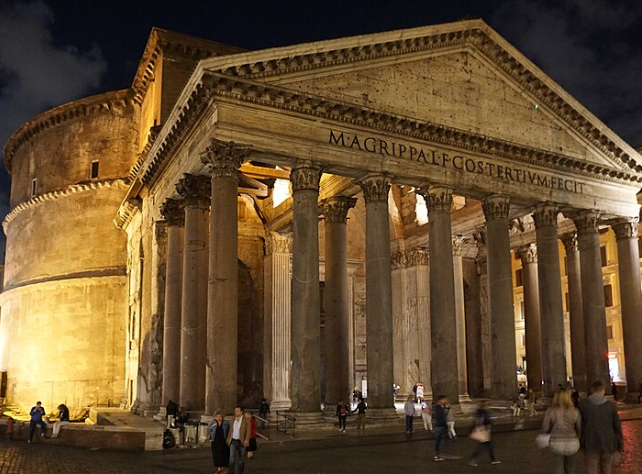
Pope Urban VIII in 1632 commissioned Bernini to add two turrets to the structure. These replaced a 13th century bell tower located on the portico. Not popular with many Romans, they nicknamed them the “ass ears of Bernini”, removed only in 1883. Bernini, it seems, learned a lesson from this episode in his otherwise illustrious career. In the next papacy, Pope Alexander VII, decided to upgrade the environs around the structure and renovate the interior space. He asked Bernini to resurface the oculus and
bedeck the dome with the Chigi family crest, six mountains with an eight-pointed star, a request, respectfully, and very untypically, demurred by the Maestro out of, he said, admiration for the ancient structure.

The exterior walls originally displayed different colors: white marble in the upper section and colored stucco in the lower. The attic section of the structure once held red porphyry pilasters and white marble panels removed in the 18th century by Pope Benedict XIV to decorate other buildings in the City. Some of its pieces can be found today in the British Museum. A large pedimented entrance portico (pronaos), a rectangle, half as deep as wide and as wide as high, contains sixteen, unfluted,
Corinthian, granite columns from diverse parts of Egypt. While Corinthian capitals originated in Greece, the Greeks generally preferred to employ engage in their structures the virile Doric or feminine Ionic styles. Romans, on the other hand, typically preferred the splendor of the Corinthian.

Not only are the columns very tall (40 feet), but, as well, revolutionary in their solid composition. Columns of this height are usually composite: concrete poured into cylinders and then clad with brick and travertine. Three of the columns on the left (east) side of the structure do not match the others because they were removed at an unknown date and replaced in the 17th century with columns of a different, reddish color, readily visible to the eye. The portico base originally rose five feet above the ground, but since the Middle Ages the surrounding surface has gained ground around it
because of effluence left behind by frequent flooding of the Tiber. Eight columns in front with a wide central aisle and two narrower ones on the sides support an entablature and a triangular pediment. In the Middle Ages the portico served as a marketplace. Visible now on column shafts remain the holes which once held poles that supported roofs of the stalls located inside. When the papacy returned from Avignon to the City in 1377 the market moved to a different locale. Over the course of time many vendors’ stalls returned, some owned and rented out by canons of the church. Finally in the late 17th century Pope Alexander VII ordered that all merchants’ stalls be relocated to the area of Hadrian’s Temple close to the Via Lata (now Via del Corso).
An inscription in Latin on the architrave reads in English: “Marcus Agrippa son of Lucius built this while consul for the third time”.

Above it the space in the pediment remains bare but contains clamp holes which indicate that once it held relief sculptures, perhaps, that of an imperial eagle surrounded by an oak leaf wreath and strings of ribbon. These would have symbolized the divine Jupiter, the Imperial State, the apotheosis of Romulus.
Behind the triangular pediment sits a rectangular vestibule. Statues of Augustus and Agrippa once adorned its two large highly visible niches, adding a more than slight political and dynastic tone to structure.

Between the porch and rotunda stands a link, transitional passageway on both sides of which staircases lead to an attic above and the roof. In the 16th century, apartments over the ceiling housed rooms occupied by an association of artists, the Academia dei Virtuosi, some of whose works are on exhibit in a Galleria there today.

Covered in heavily restored bronze recast by Pius IV 1565, the great wooden door remains the largest among the few in Rome surviving from antiquity. At the far left of the main door sits a smaller one, opening to stairs leading to the roof.

The rotunda drum, represents the building’s central core and consists of a cylindrical structure with six-foot wide walls set on eight massive pillars which provide support for the dome.

The drum contains a series of voids and brick arches to prevent expansion and cracking. Some of these brick arches are exposed at the base of the structure on the left side, visible evidence of the method by which the weight of the dome is transferred and distributed throughout the whole.

A solid ring of concrete over 7 feet wide and 4 feet deep provides the foundation and base of the structure. The wall of the rotunda, a cylinder, contains three superimposed sections. Gigantic piers embedded in the eight internal niches break the rotunda support the whole structure. The secret to its impressive durability lies with relief arches deeply embedded throughout the entire structure. As the dome rises higher and higher, the lighter its weight becomes because the lower cement walls contain chunks of tufa and travertine limestone but shift gradually to small bits of tufa and pumice in the upper part of the dome as well as tiny clay pots used to create holes in the concrete. Walls had diverse color patterns: the lower colored with stucco, the upper clad in white marble. The original gilt bronze tiles of the dome were looted in 650 by Emperor Constans II.

Its extraordinary interior expresses Stoic ideals of omnipotence and never ceases to impress visitors with its detached calm. The very immensity of the space sounds a warning to those who enter that they are in the presence of the divine.
The transition from one style of architecture (rectangle) to another (circle) succeeds by virtue of the large narthex which serves as a sort of triumphal arch. The massiveness of the original bronze door also softens the contrast between the two magnificent spaces.

Across from the entrance stands a large semi-circular apse preceded by a pair of Corinthian marble columns. On each side, recesses once contained statues of the gods.

The fundamental geometrical pattern which permeates the entire structure remains the interplay of square and circle, reflected also in the checkerboard pattern of the floor. Its pavement, original, though restored by Pope Pius IX in the 19th century, consists of granite, porphyry and marble, arranged in 89 squares which enclose smaller circles. The floor provides a sharp and colorful contrast to the simple grey coffered ceiling above. It slopes slightly towards the center and catches the water falling
through the oculus high above when it rains in a barely visible drain (pluvium).

The diameter of the coffered dome is 142 feet making it the largest of its kind in the world, larger, even, than St. Peter’s. Pope Pius IX restored the ceiling to its original design. Its systematically ordered squares diminish the weight of the dome whose thickness decreases from 20 feet at its base to 6 feet at the oculus above. This pattern leads the eye to a circle at the center under the oculus which provides the only source of light for the interior, aside from the main door, and symbolizes the very eye of Jupiter, the City’s chief planetary god manifest in the sun’s rays moving progressively across the sky through the course of the day. Not only does the oculus open the temple to the sky, it appears to admit it to its inner domain. The stupendous “dome of heaven” exploits at its best the Roman invention of concrete and the application of unparalleled architectural skill which creates a unique sense of space in the building. It serves too as a compression ring which evenly distributes constriction forces at the center. The simplicity of the decorative scheme reinforces the impression of the architectural perfection of the mammoth structure which weighs five thousand tons and whose remarkable proportions,142 feet wide and 142 feet high, reflect the perfection of its design.
Bronze plates once covered the coffered ceiling (140 panels) which Emperor Constans II removed in 655 AD by Emperor Constans II. Cassettes in the five rows of coffers contain rose patterned centers, 28 in 5 rows of concentric circles, and diminish in size and thickness as they rise from its base to the summit. In so doing, they dramatically diminish the overall weight of the dome. Only the oculus, designed to provide a view to the realm of the planetary gods, provides light to the building. Originally it had a moveable cover (clypeus).

The keystone of the rotunda consists of a 4.5-foot brick ring around the top whose bronze inner edge is original.

In 395 AD the Christian emperor, Theodosius, ordered the closure of the Pantheon along with all other pagan temples throughout the Empire. Consecrated in the 7th century as a Christian church, Santa Maria ad Martyres, it became the very first pagan temple in history converted for Christian worship and was dedicated to the Blessed Mother and to all those who suffered martyrdom in the City. The Church’s feast of All Saints has its historical origins in this very place. The main altar and choir stalls remain from 18th and 19th century renovations. On the apse wall hangs a 7th century copy of an icon of the Madonna discovered in 1960 as underlayer to a more recent painting. The original hangs in the Chapel of the Canons at St. John Lateran.

A contemporary Brescia artist, Federico Severino, designed the stations of the cross, ambo, and the gilded bronze high altar, installed in 2018. Spectacularly, on the feast of Pentecost rose petals drop to the floor from the oculus above.
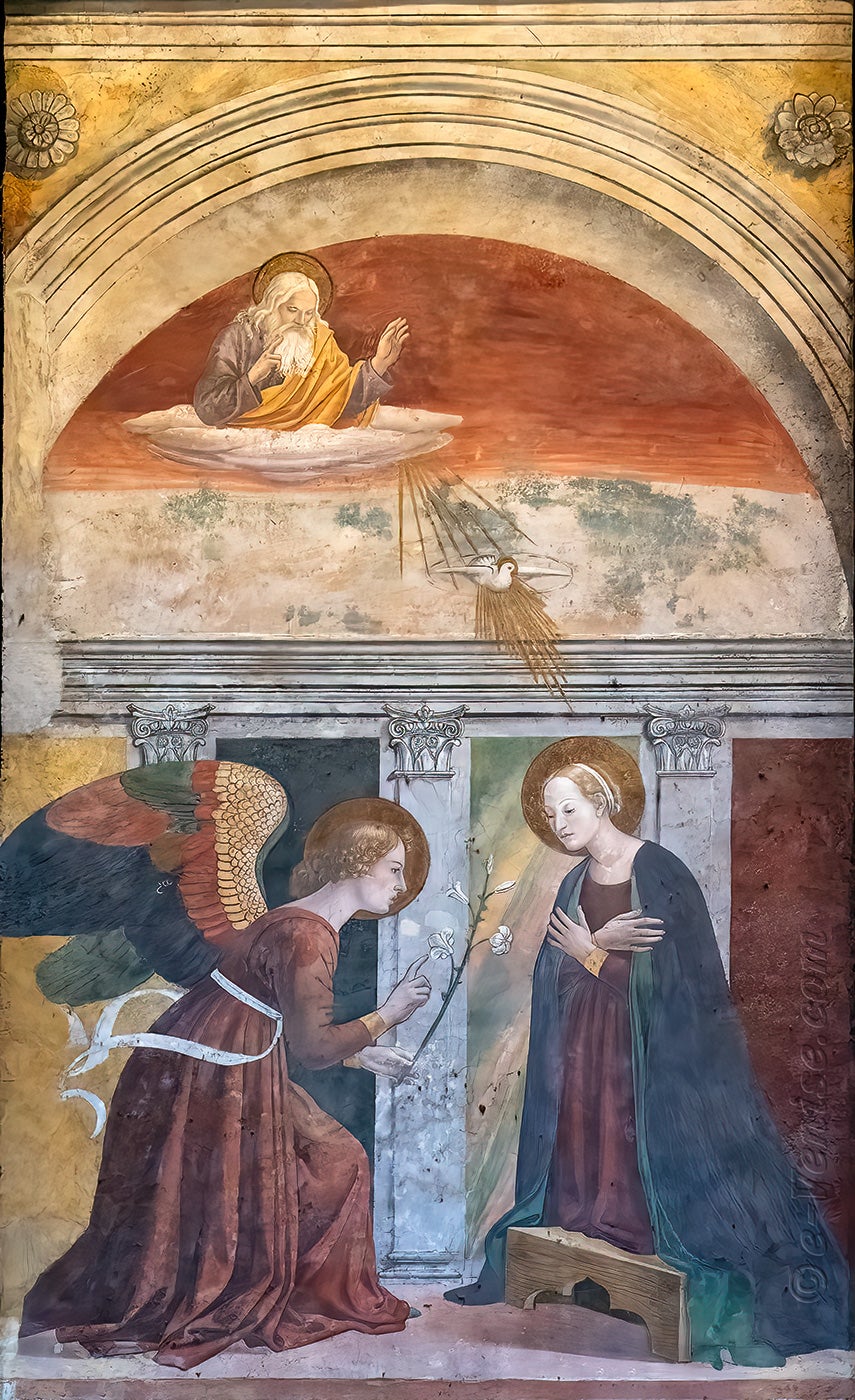
Annunciation Chapel, 2nd chapel on the right, contains a fresco of the 15th century Annunciation attributed to Melozzo da Forli.
The metal of the King Victor Emmanuel II tomb, in the 4th chapel on the right, derives from the bronze of the cannons of Castel Sant’Angelo, the very same bronze Urban VIII had stripped earlier from the Pantheon’s portico.

On the left side near the altar resides Our Lady of the Rock chapel and the tomb of the Renaissance artist Raphael who died very suddenly and prematurely on Good Friday, 1520, aged thirty-seven. For three days his body lay in state here in the Pantheon. His last painting, the Transfiguration, stood behind his catafalque. During the visitation Pope Leo X knelt beside him and kissed his hand.
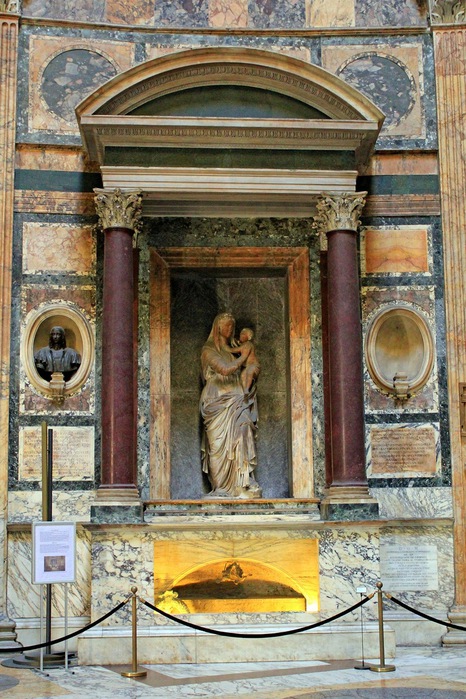
In 1833 Raphael’s body was disinterred and placed in the current Roman sarcophagus provided by Pope Gregory XVI. On it is inscribed the epitaph written by his good friend, the scholar Pietro Bembo, composed in Latin. In English it reads: “Here lies Raphael, by whom the mother of all things feared to be overcome when he was alive, and while he was dying, (feared) herself to die”.

Cardinal Bibbiena’s niece, Maria Bibbiena, Raphael’s long-time (6 years) fiancee, lies interred in a tomb to the right of his sarcophagus. She had just a few weeks before Raphael.
The statue known as the Madonna of the Rock, commissioned by Raphael himself and sculpted by his friend and associate, Lorenzetto, adorns the tomb from above. Close to the Raphael burial site, the Pantheon houses tombs of other well-known Renaissance artists: Baldassare Peruzzi, Pierino del Vaga, and Giovanni del Udine. Some later Baroque artists would find final resting places alongside them as well: Annibale Carraccci and Taddeo Zuccheri.
