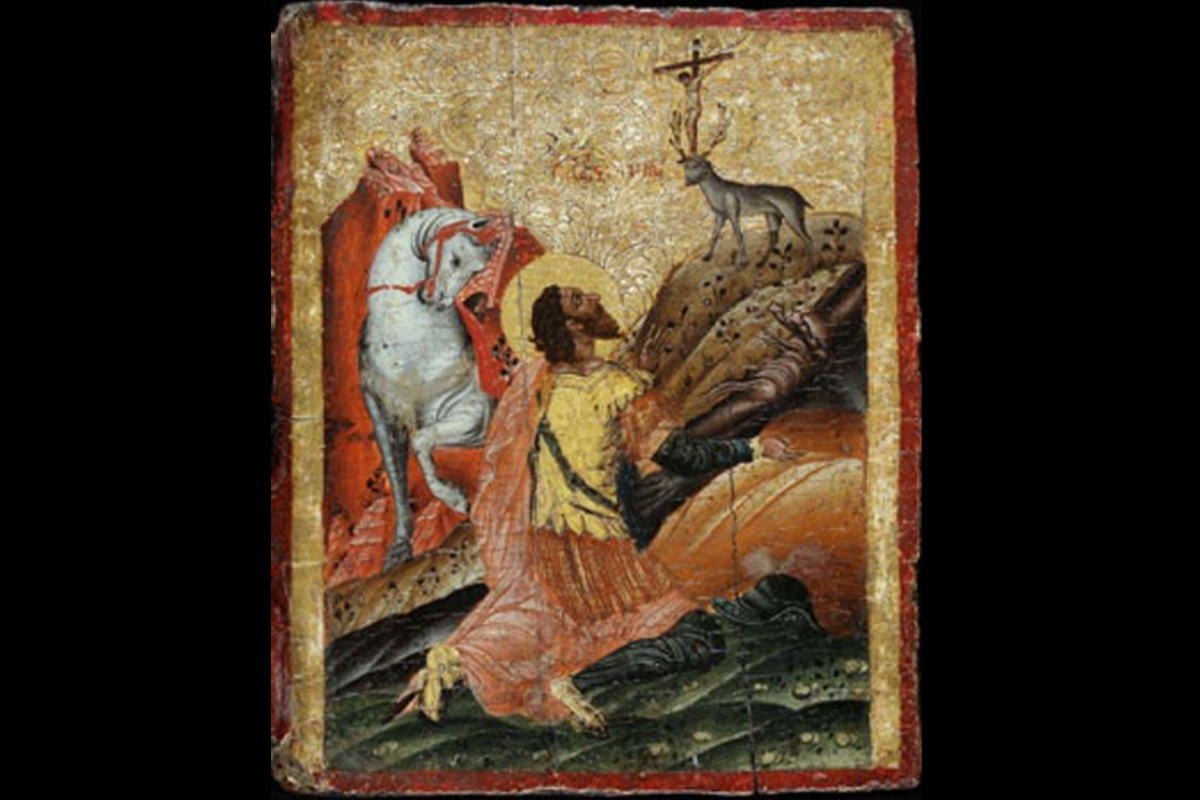
Sant’Eustachio, a small, neighborhood church dedicated to St. Eustace, venerates him as one of its early Roman martyrs. This soldier whose birth name was Placidus, served with distinction in the Roman army in the late 1st century during the reign of Emperor Trajan. He had moved from the rank of private to that of general in his short career. Placidus unexpectedly converted to Christianity after a strange, chance
encounter with a magnificent, white stag during an ordinary, run-of- the mill deer hunt. Singlehandedly he pursued the beast for a long time until, finally, he spotted it high above on a rock. Between its horns appeared a cross refulgent with rays as brilliant as those of sun together with the figure of Christ who called out to him: “I am Jesus Christ who has come here in this beast whom you hunted, so that now I may hunt you.” Placidus fell to his knees, embraced the Christian faith, and immediately sought and received baptism from the bishop of Rome who changed his name to Eustace and that of his wife to Theospis. (Roman Martyrology)
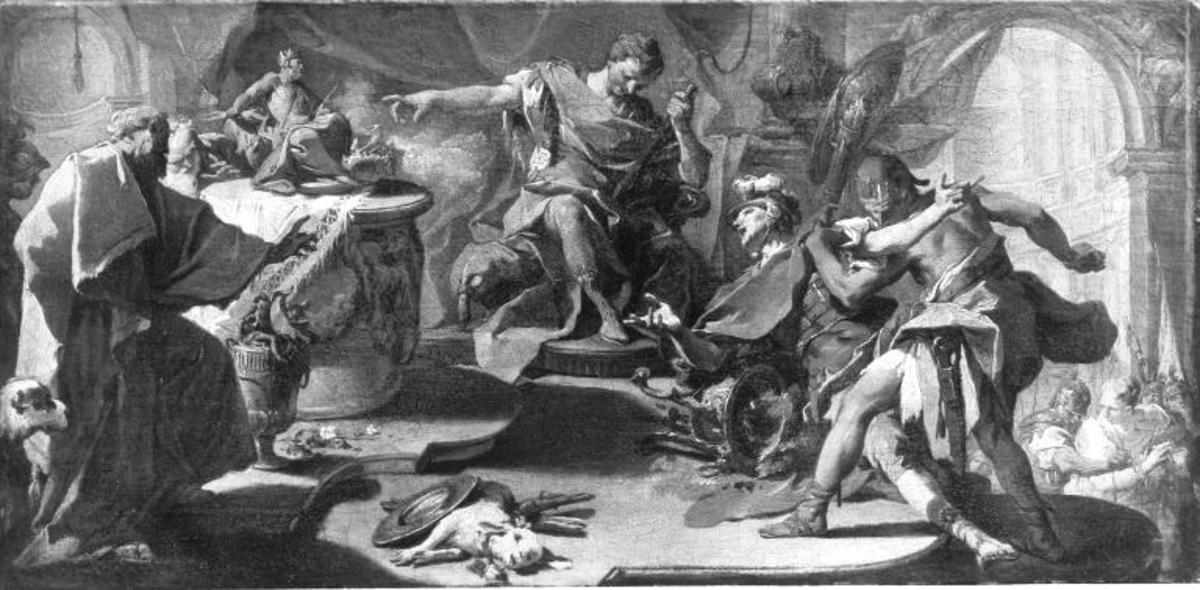
During the rule of Emperor Hadrian, when ordered to sacrifice to the god Jupiter in thanks for a military victory he had won, this general refused. The emperor had him thrown to the lions which, at the sight of Eustace, responded like pets. Finally, soldiers martyred him and his entire family by roasting them inside a hollow bronze bull. During the Constantinian age Christians erected a chapel on the site of his death.
In the Middle Ages the chapel became a diaconia, a center for the distribution of goods to the poor. At the end of the 12th century, the restoration of the church and the construction of the belltower (campanile) began during the regime of Pope Celestine III. When Pope Boniface VIII established nearby the University of Rome in 1303 (La Sapienza), the City’s first institution of higher learning, Sant’ Eustachio served as its church until the later construction of the Borromini church of Sant’ Ivo in the 17th century. Because of damage caused by frequent flooding in the Campo Marzio area, the church required reconstruction in the 18th century. The white brick church plan includes an entrance loggia, a nave of three bays, aisles on each side, the transept, and a large semi-circular apse.

Only the red brick, two storied, Romanesque campanile (belltower) whose top reflects light with its glazed, multi-colored pottery plates, remains from the 12th century church.

Pilasters and Ionic columns line the lower part of the facade. At the top rests a triangular pediment with a round window and over it a stag head with a cross between its antlers, symbol of his conversion experience and for centuries in Europe adopted as the symbol of hunters whose patron saint is this same Eustace.

The Baroque interior of the church radiates with rich gilded stucco appointments. A small baptistery sits at the left side of the entrance.

Next to the church on the left side still stands a narrow, three-storied apartment building with simple framed windows. Here St. Philip Neri lived for a few years in the mid-16th century before he founded the Oratory in 1556, an astounding development for the City in the period of the Counter-Reformation because of its long-term, positive spiritual effects on the City’s residents.

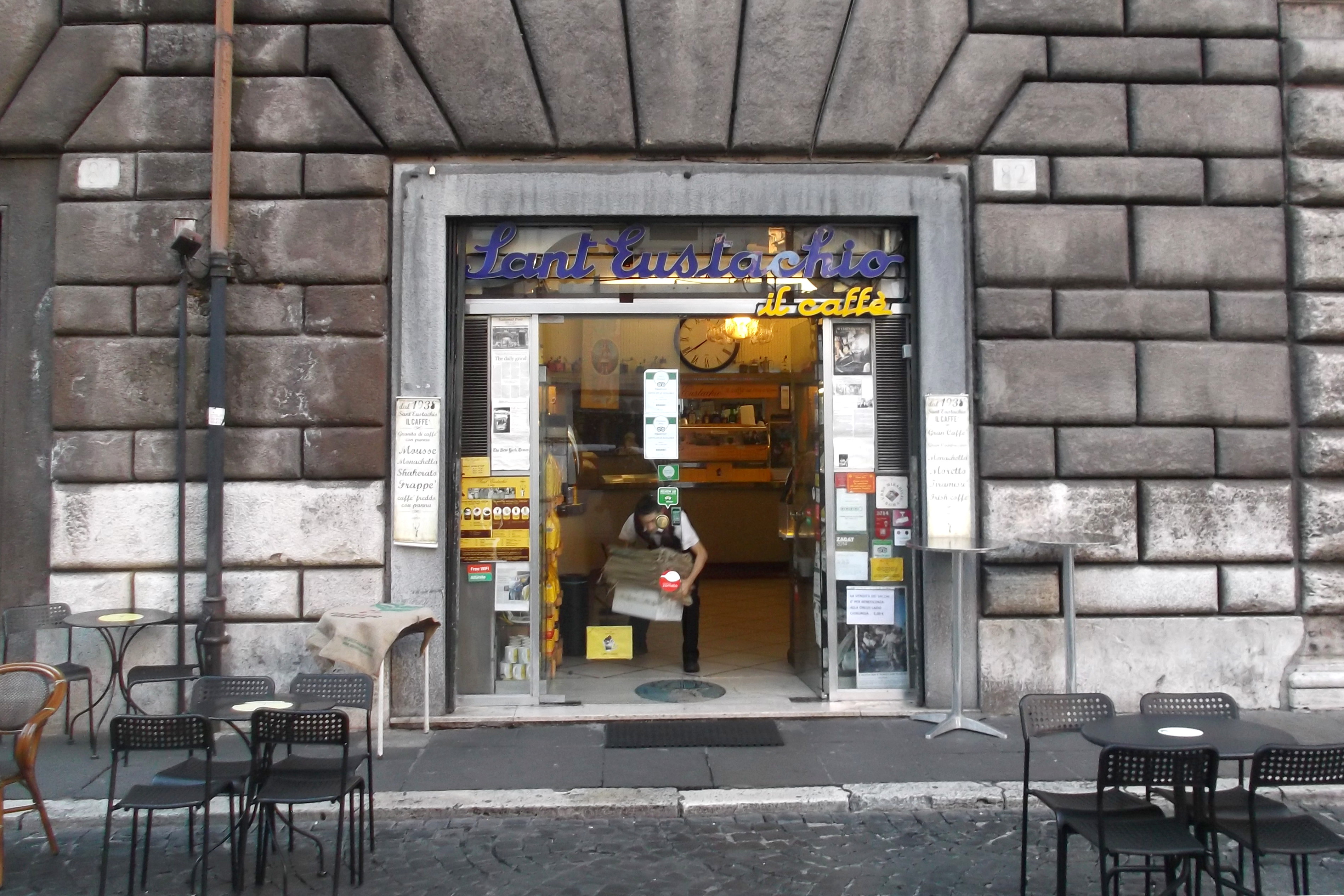
On the same block as the church, the small Café San Eustachio which, along with the Tazza d’Oro near the Pantheon, many locals and tourists regard as the best of the City’s many wonderful coffee bars.