Pope Julius II, almost immediately after his papal election, invited to the City from Milan the acclaimed Renaissance architect, Donato Bramante. Bramante, a painter and architect, had served as chief architect in the Milanese court of Duke Ludovico Sfrorza. When French forces drove Sforza family from Milan in 1499, Bramante found employment with Cardinal Guiliano della Rovere.

The cardinal invited Bramante to the City to create for him, a shrine, to St. Peter (the Tempietto) outside the church of San Pietro in Montorio on the Gianiculum Hill, the site where, in medieval legend, Peter was crucified. Della Rovere became pope in 1503 and almost immediately he commissioned Bramante to rebuild St. Peter’s Basilica. Before his death in 1514, one year after that of his patron, Pope Julius, Bramante enjoyed great success with important architectural projects: the Tempietto on the Gianiculum, St. Peter’s Basilica, the Belvedere Courtyard in the Vatican, the Castel Sant’Angelo loggia, the Palazzo della Cancelleria courtyard, and the Santa Maria della Pace Cloister. Contemporary art historians credit Bramante for introducing to the City the High Renaissance style of architecture which influenced the direction of Western architecture for generations to come.

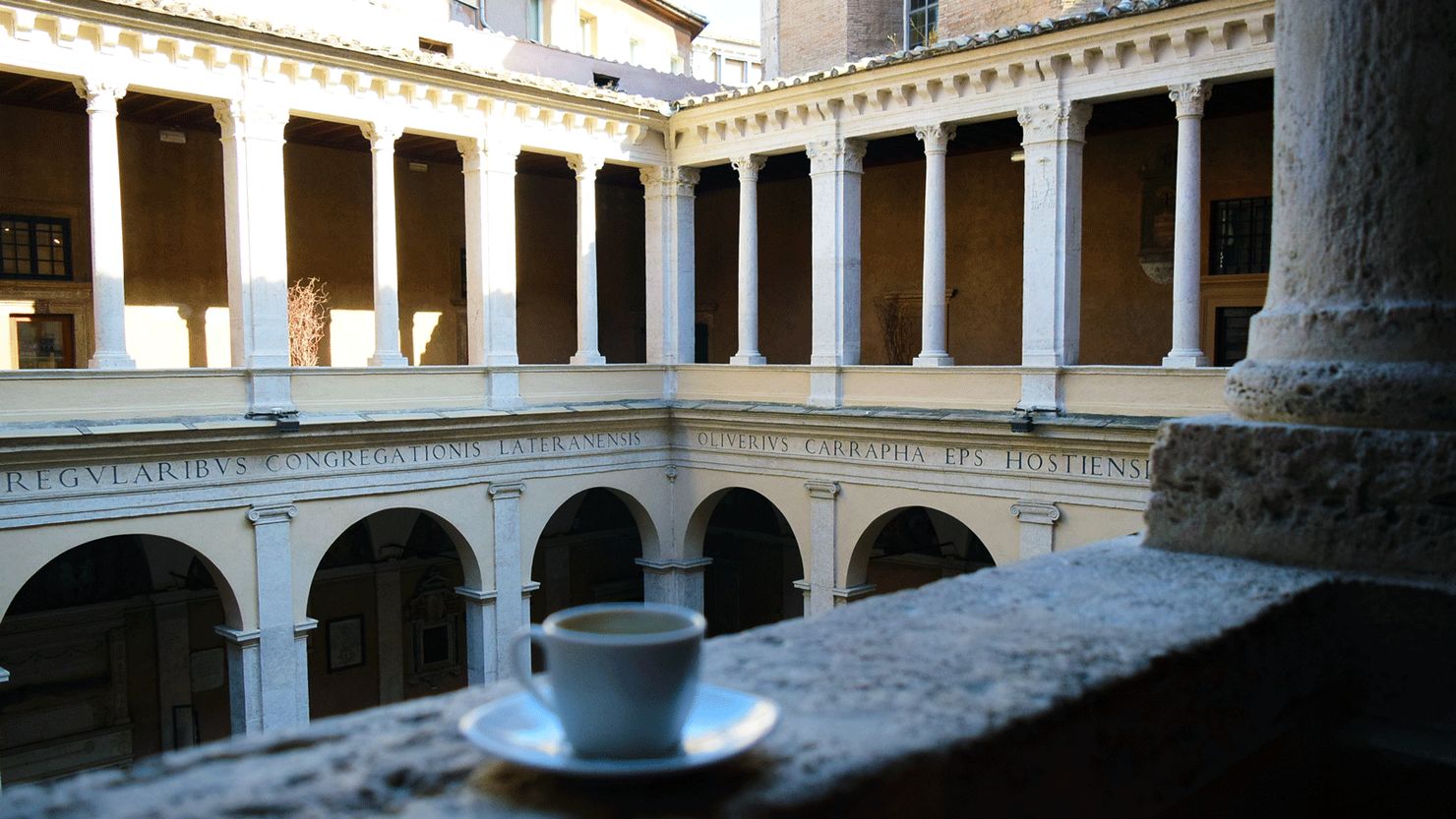
The influential Neapolitan Cardinal Oliviero Carafa, art patron and uncle of the future Pope Paul IV, took advantage of Bramante’s presence and quickly commissioned him around 1500 to create one of his best architectural achievements, mostly unrecognized and overlooked by general the public, the magnificent abbey cloister of the Canons of St. John Lateran, part of a larger complex consisting of a monastery attached to the Church of Santa Maria della Pace. In it Bramante successfully incorporated the best aesthetic features of Renaissance architecture with its emphasis on resurrecting classical Greek and ancient Roman spatial norms: symmetry, balance, harmony, equilibrium, proportionality, geometry, sobriety, and simplicity.

The cloister forms a perfectly self-contained, sober, lightly decorated, square space, harmoniously and delicately proportioned. It consists of two stories, each with its own architectural order. At ground level, the communal space of the monastery, a broad portico opens to a spacious courtyard supported on all sides by arches and pilasters with Ionic capitals, an arrangement relatively new to Roman Renaissance architecture which typically employed columns to support the loggias of courtyards.

The light upper floor (residential quarters) contains an open gallery with Corinthian columns and pilasters aligned perfectly with the arches below. Ordinarily Renaissance architects avoided the direct placement of apertures and posts above their counterparts below. Bramante, resolved happily the spatial problems he encountered in the structure (the considerable height differentiation of the two stories) by employing a variety of novel architectural techniques including the principle of not super-imposing columns over piers and, as well, placing an upper trabeated (horizontal beams) construction over and arcaded one. Stone seats along its wells provided for the monks places for reading, prayer and meditation.

Funerary monuments abound along the walls of the walkway. Lunettes at the top of these walls display frescoes depicting episodes from the life of the Blessed Mother.

Cardinal Carafa’s name (sometimes misspelled) appears on door lintels and his coat of arms adorns many decorative elements of the cloister. A dedicatory inscription acknowledges his role in the construction of the cloister.

The cloister regularly hosts concerts and exhibitions, houses a bookstore, and features one of the City’s most attractive settings for a delightful coffee bar.