
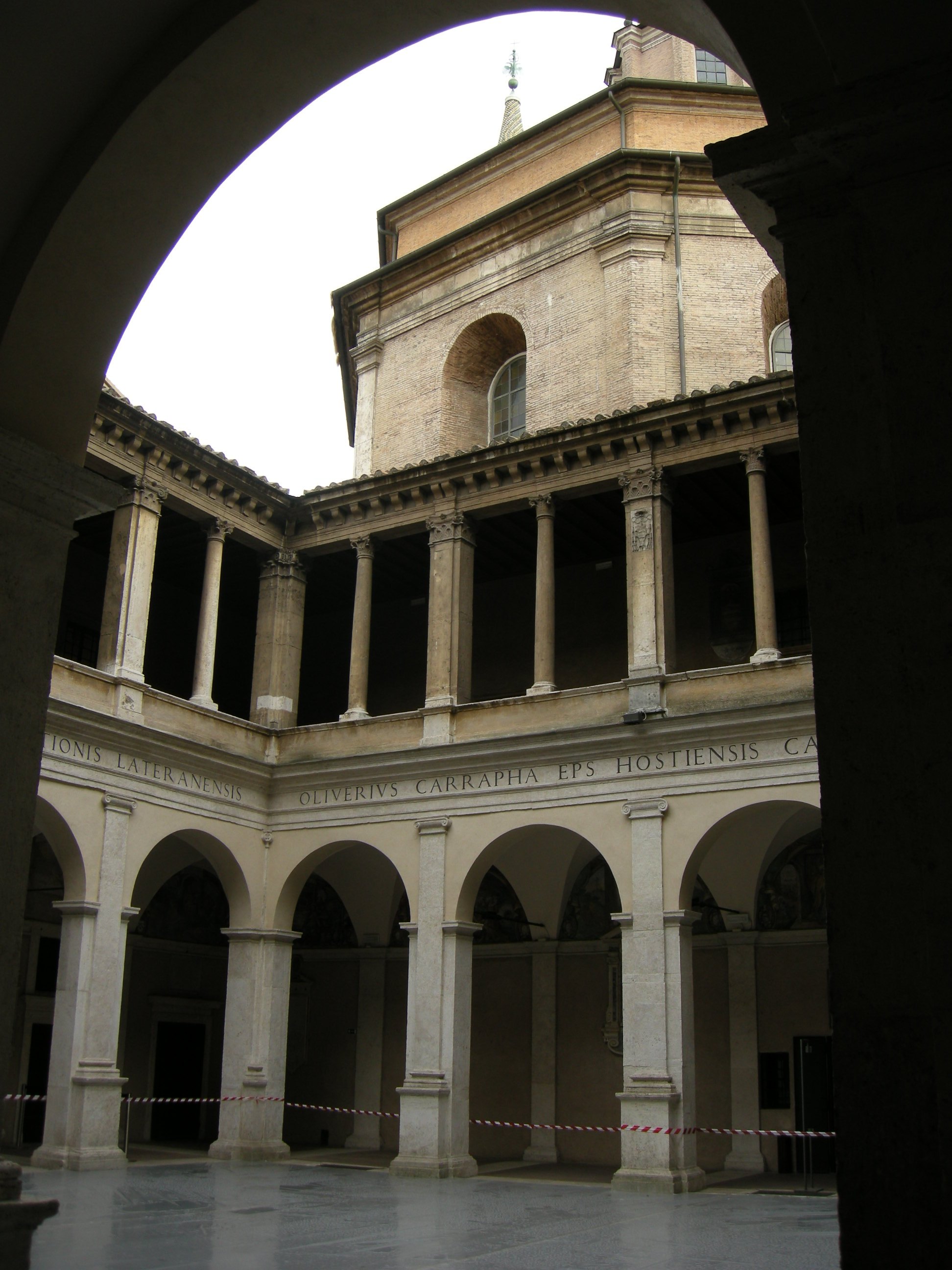
Legend has it that early in the reign of Pope Sixtus IV (1471-1484), a Protestant threw a stone at an icon of the Virgin Mary housed in a neighborhood church. The stone struck the Madonna’s face from which blood oozed. When apprised of the incident, the pope visited the site and promised the Virgin that if she helped to restore peace among warring factions in Italy, he would rebuild the church in her honor. In 1482 the wars connected to Pazzi conspiracy against Medici family in Florence came to an end and the pope commissioned Baccio Pontelli to design and build the church as he had promised. A lovely dome with its octagonal drum designed by Antonio da Sangallo was constructed almost a half century later and is most visible from the Bramante Cloister commissioned earlier (around 1500) by Cardinal Oliviero Carafa. Augustino Chigi, who had a special devotion to the Madonna della Pace, sponsored the first chapel on the left side of the church. Over a hundred years later, Pope Alexander VII, himself a Chigi, charged Pietro da Cortona with the remodeling of the church in the baroque style.
Though never fully completed, the portico, however, became the focal point of the façade. Cortona’s dramatic façade and semi-circular portico have an unusual modern look. Their two concave wings seem to point to side aisles which do not exist. Both serve, instead, as alleyways – the one on the right leading to the neighboring church of Santa Maria del Anima and the other, to the adjacent monastery. The interplay of the characteristically concave and convex Baroque forms in and around the facade creates the illusion of breadth and effectively catches the eye of spectators passing through the tiny piazza in front. An inscription on the frieze of the entablature in the portico contains a verse from Psalm 72 with the prayer that the ‘mountains bring forth peace and the hills justice’ (suscipiant montes pacem populo et colles iustitiam…), probably an allusion to the mountains on the coat of arms of Pope Alexexander VII on the upper story of the façade.
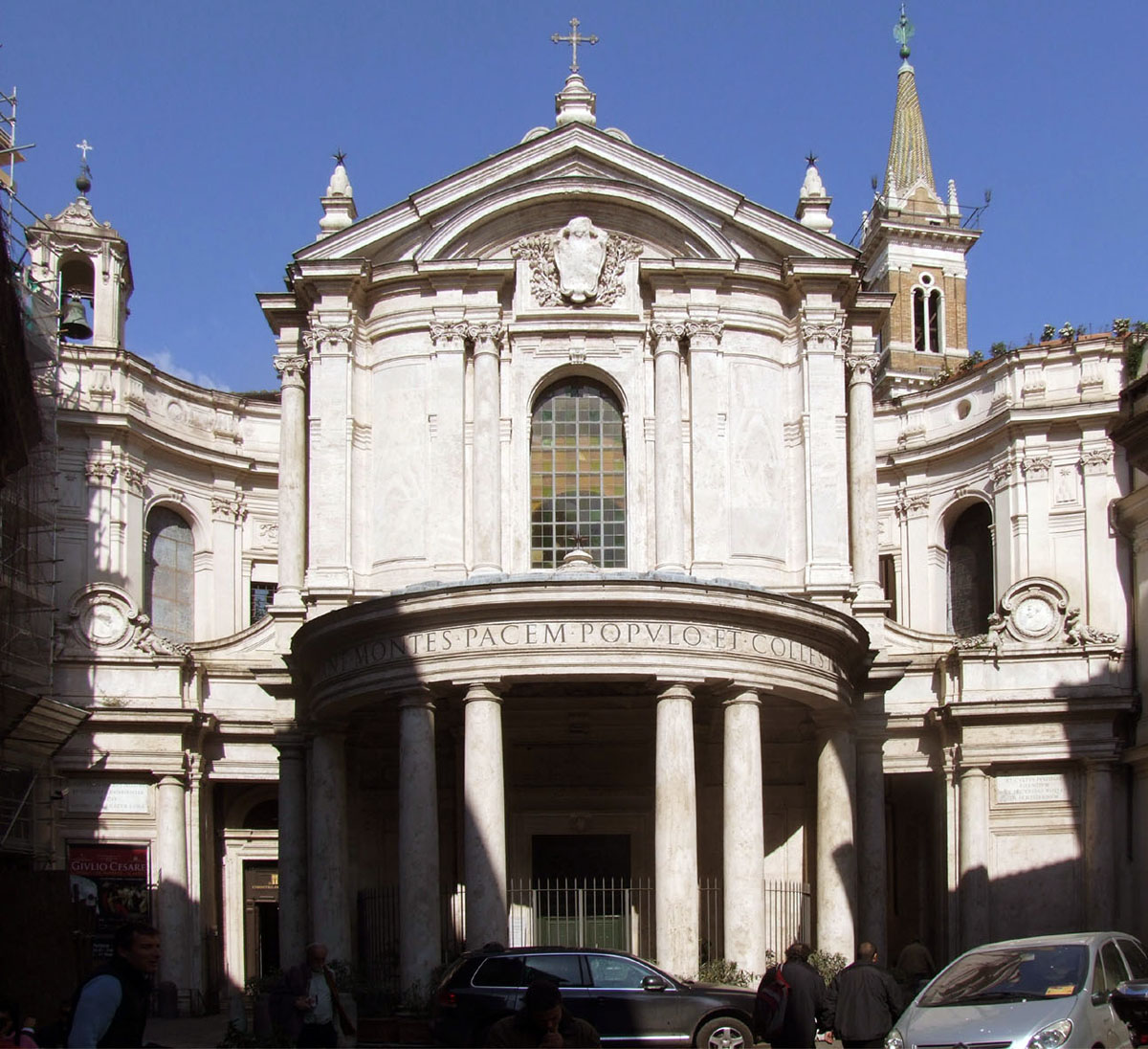
Pope Alexander VII, a self-styled “ampificator” (widener, enlarger of space), commissioned and instructed the artist, Pietro da Cortona, to design the piazza sufficiently broad enough for carriages to approach and turn around. In 1656 Cortina tore down all houses facing the piazza, completely refigured it, and created a small, five-sided public space. Entranced by the beauty and symmetry of Cortona’s work in front of the church, the pope then ordered the attachment of a plaque to a nearby building, #13. It announced the imposition of severe penalties (‘pena grava’) upon those who would attempt to alter in any way the appearance of the piazza
through construction of new edifices.

A somewhat oddly designed interior centers around a short nave of two bays with four side chapels, an octagonal transept with four side chapels and a small rectangular sanctuary apse.

Carlo Maderno designed the high altar in the sanctuary.

It accommodates the centerpiece of the church, the highly venerated icon of the bleeding Madonna della Pace, above which, in the entablature, reads in Latin, “Mother of God” (Mater Dei).

Side chapels cut into the thickness of the church walls themselves. Painted mostly in white, the interior space subtly underscores the beauty of its frescoes and other appointments.

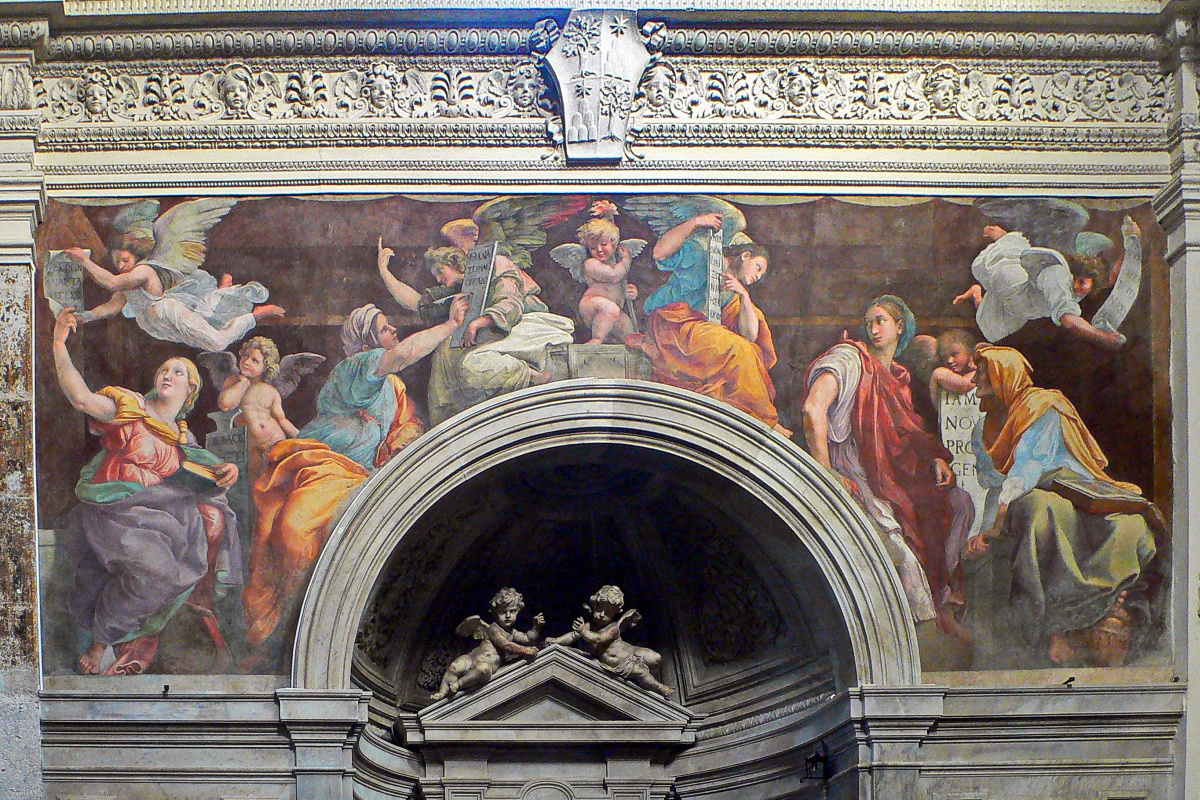
The first chapel on the right side of the nave, the Chigi Chapel, amply justifies its reputation as the source of the church’s notoriety. Its patron, Agostino Chigi, a wealthy, 16th century banker, commissioned Raphael in 1514 to execute the wall frescoes over the arched niche. The chapel consists of little more than a small altar, altarpiece, 2 statues of Sienese (Chigi hometown) Saints Catherine and Bernardino, and wall frescoes. Raphael painted much of the central fresco (Cumaean and
Persian Sibyls), but when, unexpectedly he died (1520) before completion of the side walls, his pupils completed the remaining Phrygian and Tiburtina panels. Throughout the Middle Ages it was believed that the Sibylline Prophecies had been maintained in written form in diverse ancient Roma temples. Some of these prophecies had foretold the future coming of Christ and the Christian church. Three Sibyls are depicted as young girls, the fourth as an elderly woman. The Phrygian Sibyl incorporates the true-
to-life representation of the face of Olympia Cognati, ‘La Divina’ (Queen of the Courtesans), one of the best-known Renaissance courtesans of the City and friend both of Agostino Chigi and Raphael himself. Raphael’s apprentice, Timoteo Viti, frescoed the other Old Testament prophets.
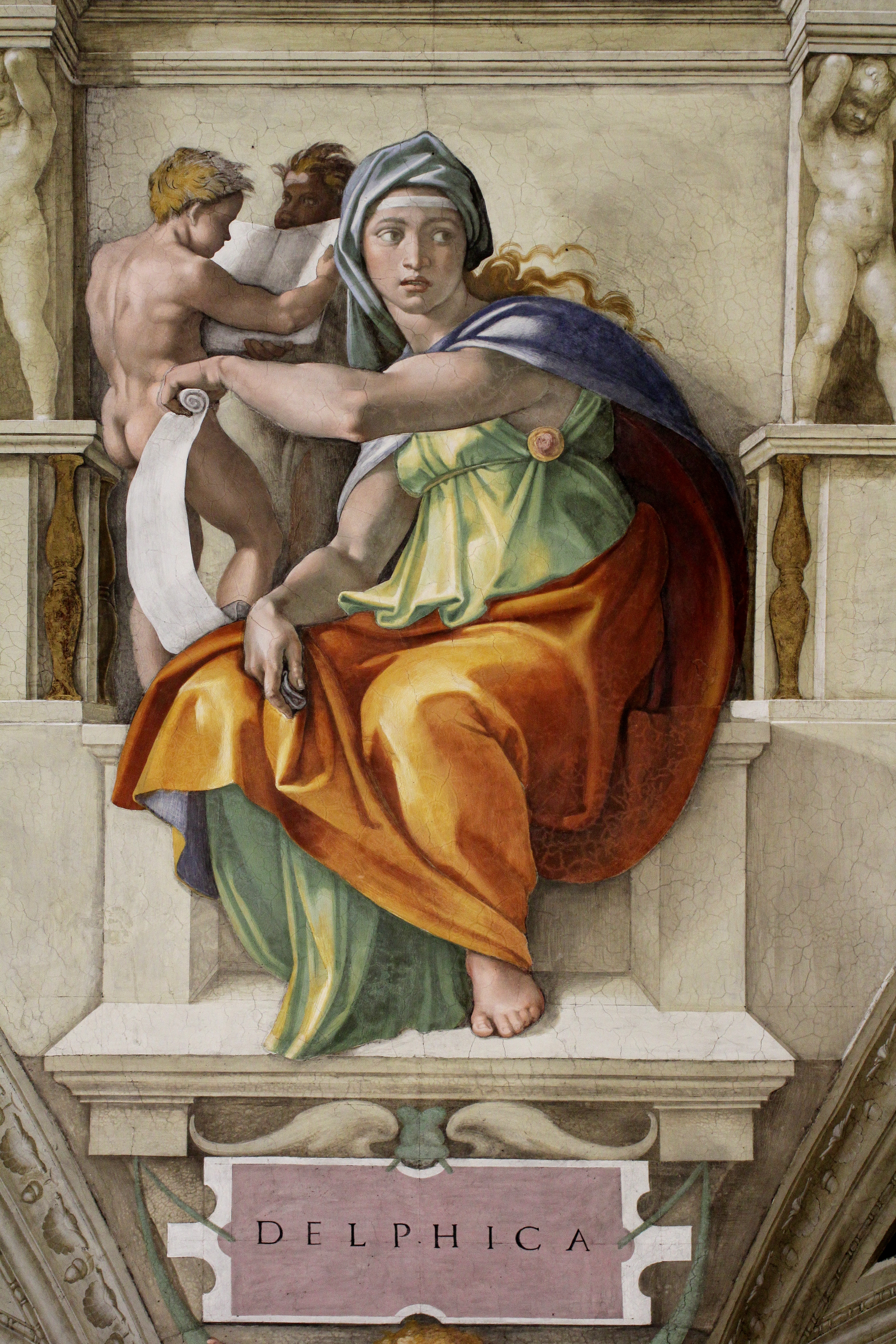
Michelangelo’s Sibylline frescoes in the Sistine Chapel clearly had influenced these Raphael’s images. Above the master’s frescoes, Raphael’s disciples painted other Old Testament prophets: Hosea, Jonah, Daniel and David.
Next to the Chigi Chapel resides the 16th century Cesi Chapel, designed by Antonio da Sangallo the Younger and constructed from marble stripped from the Capitoline Temple of Jupiter Optimus Maximus, the focal point of Roman public worship in the Republican and Imperial Ages. It’s highly ornate front, decorated with sculptures in bas relief, is regarded as the masterpiece of the sculptor,Simone Mosca, a contemporary of Michelangelo.

Some of the City’s best known Baroque artists produced other works in the church: Baldassare Peruzzi, Carlo Marrata, Cavaliere d’Arpino, and Caravaggio’s peer and often-times rowdy friend and companion, Orazio Gentileschi, who painted the Baptism of Christ.
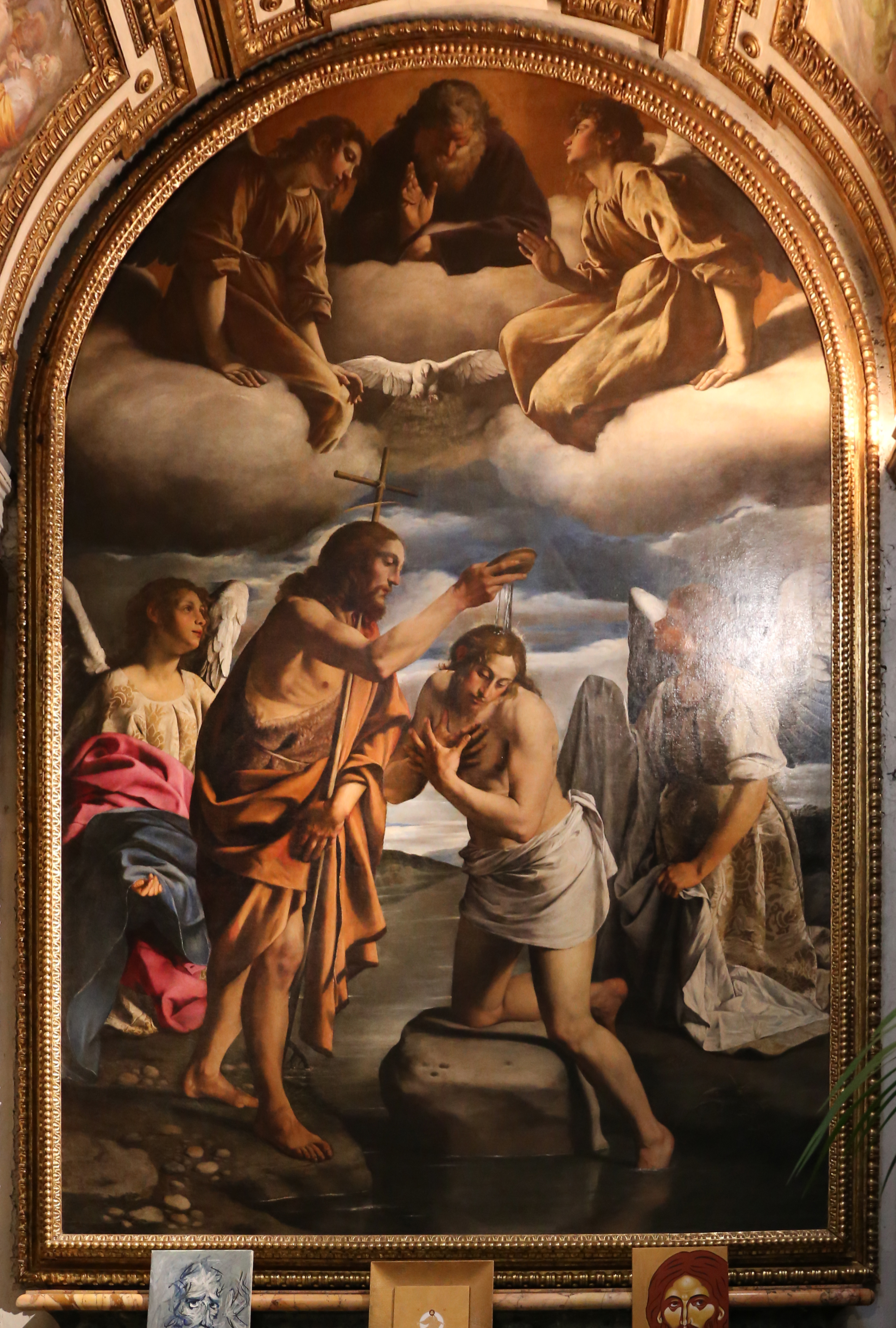
A chapel in the left transept, Capel of the Crucifix, contains on a side wall the painting of Saints Martha and Mary by Artemisia Gentileschi, daughter of another more famous Baroque artist, Caravaggio’s good friend, Orazio Gentileschi. Artemisia was one of a handful of accomplished and successful female artists of the 17th century. Her works, Caravaggisti in style, have claimed considerable attention among contemporary art historians and social commentators. Major art institutions and galleries have exhibited her works with great success.

One of the City’s first and most beautiful Renaissance structures but, oddly enough, not much visited by tourists, the Cloister of Bramante, sits attached to the church. It belongs to the small but impressive monastery of the Canons of Santa Maria della Pace.

Via dei Coronari, the road which runs along the back of Santa Maria della Pace, leads to the hill of Monte Giordano. Constructed for the Holy Year of 1475 by Pope Sixtus IV, he intended to create a long road from the Tiber to Campo Marzio for pilgrims enroute to and from St. Peter’s. Regarded by many the most picturesque, Renaissance street of the entire City, it is lined with ancient palaces: Palazzo Lanceotti, Palazzo del Drago, Palazzo Taverna,and Palazzo di Monte Pieta). Wonderfully maintained shops maintain an aura of their historic provenance. The road takes its name from the rosary makers and sellers who plied their trade with pilgrims en route to the nearby St. Peter’s Basilica. Raphael dwelled in a house on the street (#124) and, as well, wealthy courtesans, among whom, Fiametta Michaelis, the mistress of Cesare Borgia.

In the same neighborhood rises an impressive, artificial hill, Monte Giordano, formed in ancient times from rubble removed from nearby Tiber River. In the Middle Ages the powerful Orsini fortified the hill and at its peak constructed their spectacular 15th century Palazzo Taverna.

Just a few blocks away from Santa Maria della Pace, stands on Via di Santa Maria dell Anima, # 64, the church of the same name. Martin Luther called it the ‘German church’ and regarded it as the ‘best’ of the City’s churches, the one in which he felt most at home.
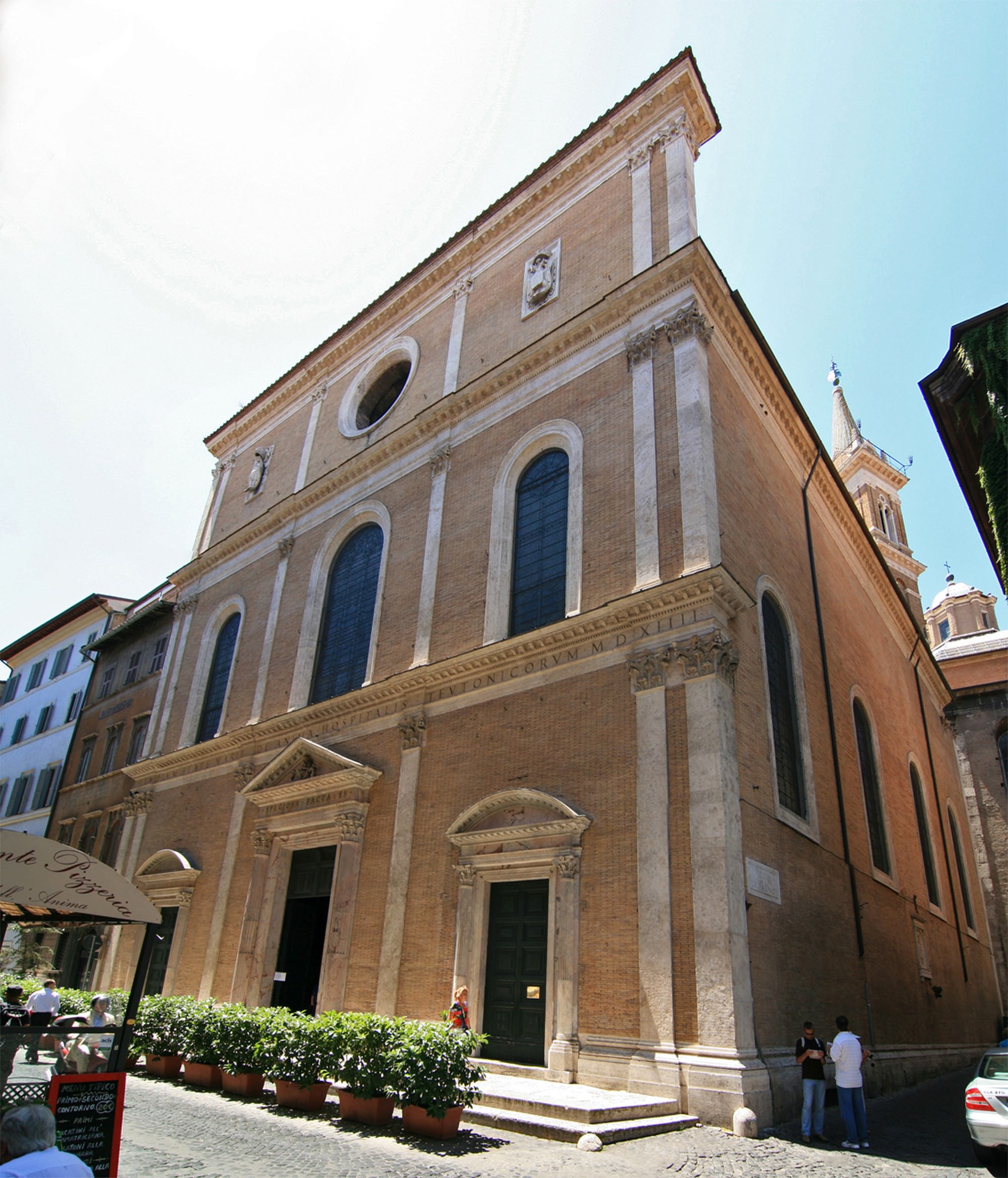
Ironically, given their role in the story of the Protestant Reformation led by Luther, one of the benefactors of this church was the Fugger family, lenders of great sums of money to the papacy and German hierarchy. The only Dutch pope in the history of the Church, Adrian VI (Adriaan Florizoon), once the teacher of Emperor Charles V, is buried within its walls. Born in Utrecht, a beer maker’s son, it was his imperial student who foisted upon the papal conclave the candidacy of his former teacher. The Romans despised him and regarded him as a barbarian because of his harsh, ascetic, and rigid personality and style. Unlike his predecessors he despised the fine arts, found repugnant the frescoes of the Sistine Chapel, and went so far as to lock up the Belvedere Gallery which housed the Laocoon. When he died in 1523, Romans celebrated the event by bedecking the door of his physician’s house with flowers and thankful words: ‘from the Senate and the Roman People to the liberator of the Fatherland’. His papacy also spawned the local proverb that the City ‘always suffers under popes whose number is VI’.

Adrian VI rests peacefully now in a magnificent tomb designed by Baldassare Peruzzi, in this, the City’s most German church.
