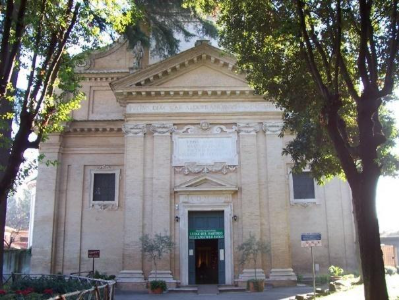
Since the 6th century Christians have associated the site of the martyrdom of St. Paul with the church of San Paolo alle Tre Fontane. This sacred place stands near the third milestone outside the City on the ancient Via Laurentina where, according to legend Roman soldiers beheaded St. Paul. His head bounced three times and springs miraculously erupted in spots where it touched the ground. Proof of the miracle, legend says, was that the water of the first spring was warm, the second tepid, and the third cold. Friends carried Paul’s body two miles away to a private cemetery on the property owned by a Christian woman named Lucina. They erected a memorial (tropaeum) over the gravesite above which in the 4th century the emperor Constantine constructed the great basilica, San Paolo fuori le Mura.

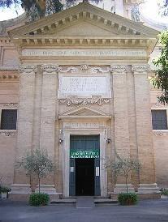
The earliest church on the site originates in the 6th century when the Byzantine general Narses ordered its construction in thanksgiving for his military defeat in 552 AD of the Ostrogoth forces of Totila at the Battle of Taginae in which the Germanic king died. Around 1602 Cardinal Aldobrandini commissioned the architect Giacomo della Porta to construct it and, as well, the third church on the property, Santa Maria della Scala. Pink brick with travertine detail makes up the San Paolo fabric. At the actual entrance, stand two pairs of Ionic pilasters whose capitals have an eight-pointed star, part of the coat-of-arms of
the Aldobrandini family. On the frieze an inscription in Latin extolls the founder of the church, Cardinal Peter Aldobrandini. Statues of Saints Peter and Paul sit on the roof and over the main door, an artistic touch which prefigures the later Baroque tendency to crown facades with its statues of saints and angels. The façade, unnoticed by visitors and inaccessible to them, lies on the left side of the church, around the corner of the entrance.
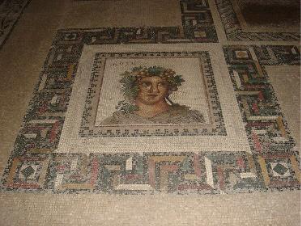
Between the entrance and the nave of the church lies a vestibule which features a restored ancient polychromatic marble mosaic floor depicting allegories of the Four Seasons, discovered at Ostia Antica in 1867 and gifted to Pope Pius IX.
In the vestibule hang two relief sculptures, Saints Peter and Paul, commissioned by Pope Pius IX for the 1867 restoration. One commemorates St. Paul’s martyrdom (AD 67), the other celebrates the defeat of the forces of Giuseppe Garibaldi at the 1867 Battle of Mentana when papal forces successfully fended off Garibaldi’s forces in their effort to seize the City and incorporate it into the newly created Kingdom of Italy. The independence of the City, however, perdured for only three years when in 1870 royal nationalist troops invaded and in 1871 declared it the capital of the unified Italian state. Above the entrance a fresco depicts transfer of the apostle’s body to San Paolo fuori le Mura. The main axis of the church lies on the same line as the slope of the hill and its springs, moving right to left as one faces the façade. The nave of the church is rectangular with apses at each end: the one on the left houses the high altar, while the other, on the right, serves as a side chapel. In the far-right hand corner of the church stands, encased in a metal screen, the
marble column to which Paul was bound before his execution.

To the left of it, set in a straight line, lie three identical aedicules set over the original three springs. Terra cotta busts of the head of St. Paul on all three serve as copies of originals stolen years ago from the church. A fresco depicting the Apotheosis of St. Paul remains in the apse. Spring water once gurgled through the channels and filled small pools from which pilgrims drank and carried away water in jugs. The monastery had to plug its source recently because the springs had become polluted and dangerous to drink.
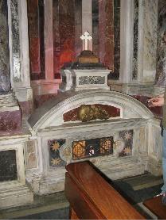
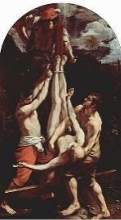
The church houses altars in two apses facing each other. Above the main altar in the chapel of St Peter sits the painting, The Martyrdom of St.
Peter, a copy of the original painted by Guido Reni in around 1605 and later transferred to the Quirinal (Papal) Palace for fear of theft or damage by moisture and, more recently, acquired by the Vatican Museum. The chapel of St. Paul retains a painting by Bernardo Passaretti, The Martyrdom of St Paul.